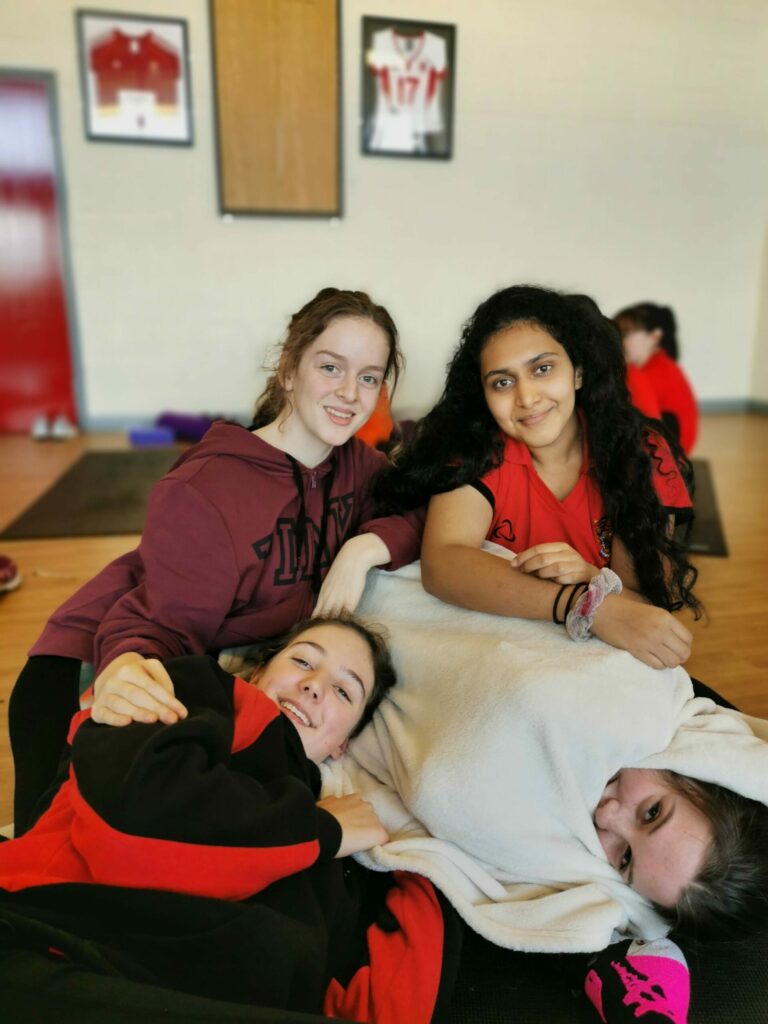
Charlotta Martinus has spent more than twenty years teaching yoga to young people. She founded the Teen Yoga Foundation, now the leading global charity in the field, and taught her first class to a group of fourteen-year-olds in North Somerset in 2003. By her own account that class was not a success, and it set her thinking about the kind of yoga a young person needs. She began training other teachers in 2005, helped found the All Party Parliamentary Group on Yoga, and has since trained more than two and a half thousand teachers and reached close to a million teenagers across more than twenty countries, Australia among them. Her submission argues that the change a student feels comes from the field a teacher creates as much as from the technique. We put a few questions to her.
You argue the change comes from something more than the technique. Do you mean we let go of traditional sequencing?
None of this means abandoning skill or structure. Picture two students in the same class, moving through the same sequence and hearing the same instructions. One leaves visibly softer, more connected, somehow reorganised. The other has had a perfectly pleasant class, useful perhaps, and yet nothing has fundamentally shifted. It is tempting to explain that through readiness or personality, and those factors do matter, but there is something else at play, closer to the heart of yoga. It goes beyond what we teach and into the context in which it is received.
Can you give me a moment where you saw that for yourself?
I remember working with a group of teenagers in a school setting, highly energetic, and not especially interested in yoga. I had planned carefully, the sequence was appropriate, breathing techniques and sound structure. In many ways it was exactly the kind of session we are trained to deliver, and yet it did not land. The group moved, but they did not settle. They followed, but they did not engage. A few weeks later I returned to the same group. Nothing externally was different, the same room, the same young people, broadly the same material, but internally something had shifted in me. I had become aware of my own subtle urgency, the desire for the class to “work”, to produce an outcome. This time I did less. As a response… I slowed my own internal pace, paid closer attention to what was happening in the room, and allowed the session to unfold with far less direction. The atmosphere changed and the practice became simpler, almost unremarkable on paper. The room softened in a way I had not seen before. One of the boys, usually restless and unable to be still, lay quietly for a full minute. Afterwards he said, with a kind of surprise, “That was… quiet in my head.”
So where did that shift come from, if not the technique?
We are often taught that the nervous system responds to techniques, slow breathing, grounding postures, lengthened exhales, and it does, but the nervous system is equally responsive to the relational field in which those techniques are offered. It responds to the teacher’s state, the pace and agenda. Students, particularly those who are dysregulated or stressed, are exquisitely sensitive to this. They do not hear what we literally say, they register how it is being delivered. It is entirely possible to guide a technically perfect practice and still transmit urgency, pressure, or expectation. When there is space and the teacher is not trying to achieve a particular outcome, things can reorganise naturally.
You put it strongly that our effort to do yoga well can get in the way of what heals.
Yes, in many cases it becomes a subtle form of control. We refine, correct, optimise, and ironically recreate the very dynamic we are trying to solve. Pressure to perform and improve, to get it right. For students who are already internally driven, this can be counter to our aims.
And when the context does change?
Everything changes in the same almost anti-climactic manner I described earlier. I see this repeatedly, in work with young people and with experienced teachers. The moment a teacher stops trying to get somewhere with a student and shows interest in what is happening, things light up. When felt experience is prioritised, the body responds well. Breath changes and stillness emerges.
What does this mean for teachers?
Practically, this means noticing our own state before we walk into the room. Are we rushing? Are we carrying some idea about what this class needs to achieve? A teacher who can settle themselves first, even for thirty seconds before starting, changes what is available to the group. It also means resisting the urge to fill every silence or correct every fidget. Stillness in a teenager often looks like restlessness right before it arrives, and if we step in too quickly we can foreclose the very shift we are hoping for.
I would say to teachers: what young people actually need from us is often much simpler than we think. Someone who isn’t trying to fix them. Someone willing to just be there while they find their own way to quiet.
ConceptualConceptual Knowledge
ProceduralProcedural Skills
ProfessionalProfessional
2003505001000
Yoga Australia CurriculumBecoming a Yoga Professional
200hours
Provisional Teacher
design, deliver, develop
350hours
Registered Level 1 Teacher
beauty, balance, becoming
500hours
Registered Level 2 Teacher
innovating, integrating, inspiring
1000hours
Registered Level 3 (Senior) Teacher
create, contribute, compassion
Conceptual Knowledge01Class Design
200hours
Provisional
Design and plan a yoga class under supervision
350hours
Level 1
Design and plan a yoga class as per the scope of practice
500hours
Level 2
Design and plan a yoga program as per the scope of practice
1000hours
Level 3
Design and plan a yoga program as per the scope of practice
Conceptual Knowledge02Human Systems
200hours
Provisional
Identify principles of human systems as applied to the instruction of yoga
350hours
Level 1
Describe principles of human systems as applied to teaching yoga
500hours
Level 2
Explain principles of human systems as applied to teaching yoga
1000hours
Level 3
Justify principles of human systems as applied to yoga
Conceptual Knowledge03Yoga Foundations
200hours
Provisional
Recognise the evolution of the philosophy and teachings of yoga
350hours
Level 1
Describe the evolution of the philosophy and teachings of yoga
500hours
Level 2
Explain the evolution of the philosophy and teachings of yoga
1000hours
Level 3
Describe and compare traditions, philosophies, and teachings of yoga
Conceptual Knowledge04Business & Legal
200hours
Provisional
Identify the main business, technical and legal requirements for yoga classes
350hours
Level 1
Identify the main business, technical and legal requirements for teaching yoga in a variety of contexts
500hours
Level 2
Describe the main business, technical and legal requirements for teaching yoga and demonstrate the ability to operate a small business
1000hours
Level 3
Describe the business, technical and legal requirements appropriate to your professional context
Procedural Skills05Teaching Methodology
200hours
Provisional
Instruct classes for healthy adults following a plan designed under supervision
350hours
Level 1
Teach classes with observational skills, balance, and ability to modify for individual and group needs as per the scope of practice
500hours
Level 2
Teach programs and workshops demonstrating leadership, inspiration and high-level observational skills as per the scope of practice
1000hours
Level 3
Create and teach programs as per the scope of practice incorporating yoga philosophy
Procedural Skills06Techniques & Practices
200hours
Provisional
Incorporate safe technique, alignment, cueing and provide modifications
350hours
Level 1
Incorporate safe technique, alignment, sequencing and provide variations for specific groups and needs
500hours
Level 2
Incorporate safe technique, alignment, and sequencing to confidently inspire and innovate the progression of participants
1000hours
Level 3
Demonstrate the ability to progress participants in a creative and compassionate manner
Procedural Skills07Communication
200hours
Provisional
Establish a professional relationship with participants, peers and other professionals
350hours
Level 1
Manage interactions with participants, peers and other professionals
500hours
Level 2
Consistently practice communicating with compassion, confidence, respect and kindness
1000hours
Level 3
Identify, analyse, and disseminate research on communication to modify and improve personal communication and influence others
Procedural Skills08Review Performance
200hours
Provisional
Review and discuss own performance and development with a supervisor and identify areas for improvement and continuing education
350hours
Level 1
Review own performance with a mentor/colleague and identify areas for improvement and continuing education
500hours
Level 2
Review own performance with a mentor/colleague and identify areas for improvement and continuing education
1000hours
Level 3
Implement self-review processes and identify areas for improvement and continuing education
Professional09Ethics
200hours
Provisional
Respect and uphold the Guiding Principles of Yoga Australia
350hours
Level 1
Respect and uphold the Code of Ethics of Yoga Australia
500hours
Level 2
Respect and embody the Guiding Principles of Yoga Australia
1000hours
Level 3
Respect and embody the Guiding Principles of Yoga Australia
Professional10Scope of Practice
200hours
Provisional
Articulate the scope of professional practice of your knowledge and skills
350hours
Level 1
Articulate the scope of professional practice of your knowledge and skills
500hours
Level 2
Articulate the scope of professional practice of your knowledge and skills
1000hours
Level 3
Articulate the scope of professional practice of your knowledge and skills
Professional11Personal Practice
200hours
Provisional
Develop your regular personal yoga practice with a more senior teacher and reflect on that practice
350hours
Level 1
Maintain a regular personal yoga practice with a more senior teacher and reflect on that practice
500hours
Level 2
Maintain a regular personal yoga practice with a peer and reflect on that practice
1000hours
Level 3
Maintain a deep personal yoga practice and reflect on that practice
Professional12Contribute to the Profession
200hours
Provisional
Contribute to the profession of yoga and the community
350hours
Level 1
Collaborate with yoga professionals and the community
500hours
Level 2
Support the profession of yoga and the yoga community
1000hours
Level 3
Offer mentorship and guidance to the profession of yoga and the yoga community
Levels build upon one another, each includes all the prior competencies.