Navigating Endometriosis with Yoga

For many, Endometriosis is a challenging journey. Years of dismissed symptoms, delayed diagnosis and interventions that offer only temporary relief or band-aid solutions. Pelvic pain has been viewed as a condition that involves management of one area of the body, rather than a systemic and whole person disease that has numerous side effects for an individual.
Yoga engages with a person’s relationship to their own body, energy, and sense of what is possible on any given day. So when Deakin University’s Mind-Body Research in Health Lab set out to investigate non-pharmacological approaches to endometriosis pain, yoga was one of three interventions selected alongside cognitive behavioural therapy and education. The result was the HaPPi Study, a three-year randomised controlled trial involving 330 participants from across Australia.
Yoga Therapist Jill Harris designed the Yoga protocol for this trial along with delivering the intervention, based on the therapeutic teachings of Krishnamacharya. Findings on the trial confirmed something yogis have long understood but the scientific world has taken time to quantify: conscious breath and movement combined, and applied in the right way for the individual, can shift the experience of pain and lead to a new awareness beyond the pain.
The study
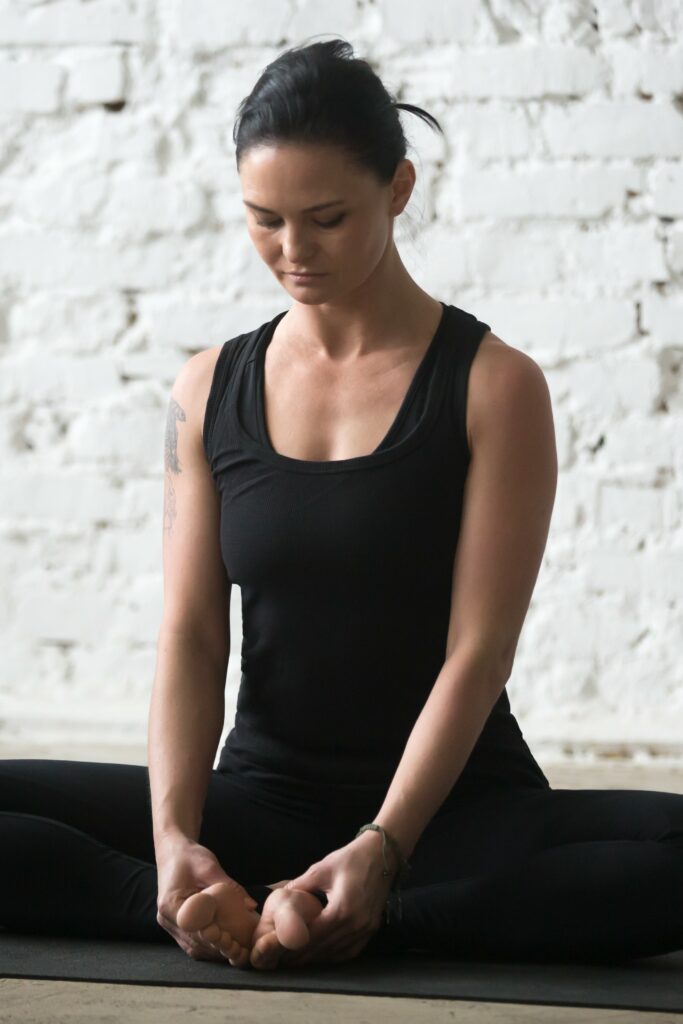
The Happi Study began during the Covid pandemic and – out of necessity – was delivered entirely via Zoom which enabled the trial to reach women all across Australia. Each of the 83 women in the yoga arm received a one-on-one Yoga Therapy session with Jill lasting about an hour, from which she built a home practice tailored to that person’s symptoms, capacity and daily life. Most practices ran around twenty minutes. Alongside this individual work, participants attended a weekly group class over eight weeks, each session introducing new elements progressively.
Endometriosis presents differently in every woman and fluctuates across the month. The combinations of back pain, hip pain, period pain, nausea, fatigue and other symptoms shift constantly. A fixed sequence would have failed most of these women before they started, so the invidualised home practice became a vital tool for participants. What is the capacity of this person and what will help them navigate their pain symptoms? That was the question the protocol attempted to answer for each participant.
Less is more
Jill’s mantra has been less is more. Some participants were very restricted in their movement – one woman completed every session from a chair because most movement was too painful. In a general yoga class she would have been left behind. In this context, the practice simply met her where she was on the day.
When movement of the body needed to be minimised, prāṇāyāma and conscious breathing became the centrepiece. Participants who came into the study with no awareness of breath left with a tool they could use anywhere, at any time, without needing a mat or a class. Much of the qualitative feedback from the trial centred on this single shift of understanding more about how the breath could be used as a tool to manage pain. As one participant put it: “I probably would have spent the entire time curled up on the couch. So, knowing that I could actually just do those gentle movements and they would actually just help me breathe.”
For yoga teachers, this raises practical questions around how to work with students when pain precludes what they have planned for their group class or practice. How can we read a student and modify in the moment to help manage their discomfort? How can we offer something useful rather than yet another child’s pose? Jill has built a protocol that gets into exactly this, drawing on three years of clinical research and the techniques developed through the HaPPi Study, and it is presented here as a CPD resource.
Working across layers
One of the most useful findings to come from the research is that the Yoga intervention doesn’t only work on a pain management level. Whilst pain was the initial symptom being addressed, the ripple effect into supporting physical, mental and emotional outcomes was significant too.
Pain that persists long enough can reshape how a person thinks. “There is always going to be pain” becomes an attitude, then a belief, then something closer to identity. This can present as mental health challenges such as anxiety and depression as limited movement of the body has a flow on effect to the mind. The condition morphs into something more complex than the original diagnosis.
Yoga’s model of the kośa-s offers clear vision of experience, from the physical through breath, mind, personality and deeper awareness. A woman might walk in with hip pain, but the place where change becomes possible might be her breathing, or her relationship to the pain itself. As one participant described it: “I’ve noticed more strength in my legs, that they want to get up and get moving. I’ve noticed my upper body wants to expand more and not be so hunched or stressed.” Something can shift beyond the physical form and the kośa-s offer a pathway to see how a shift in one layer can have a profound effect on others. This is the benefit of an individualised approach to practice where tools can be carefully selected for a particular outcome.
Beyond endometriosis
Chronic pain conditions are so prevalent that most classes will include someone managing one, and most people suffering through them have never been offered anything resembling what yoga can provide when it is taught with this kind of precision. The techniques developed through the study reach well beyond a single condition.
Krishnamacharya’s instruction stays with Jill every time she meets someone in pain: teach as it applies to the person in front of you. This CPD course gives teachers practical tools and frameworks drawn from university-level research so they can work with more confidence when a student presents with something that a standard class structure was never designed to hold.
About the Facilitator
Jill Harris has contributed to several academic research trials, including studies on Yoga for Anxiety and Depression, The Happi Study, CodeEndo – exploring yoga for Endometriosis, and recently, a small group trial investigating yoga as an adjunct treatment for Eating Disorders. Based in Ocean Grove on Victoria’s Bellarine Peninsula, Jill runs a yoga studio where she teaches group classes, offers Yoga Therapy consultations and facilitates workshops. She also leads local and international yoga retreats diving deeper into yogic philosophy, and also delivers a 500-hour teacher training program.
Deakin University’s research is continuing, with a new study called CodeEndo building directly on the HaPPi findings. The team is recruiting 350 participants for an online program investigating supportive care for endometriosis, with yoga as one of several modalities available. They are currently at around 40% recruitment and looking for more women to take part. You can find out more and register at codeendo.deakin.edu.au.