Permission to Believe

A reflection on yoga, colonisation, and the strange fate of living traditions
I was in a café in Gokulam, the Mysore neighbourhood that has become a kind of pilgrimage site for Western yoga practitioners owing to TKV Krishnamacharya’s presence in the 20th century. A young Indian man working behind the counter noticed the triśūla tattoos on my arms and studied them for a moment before asking, with seeming incredulity: “Do you really believe in that?”
The question carried a tentativeness, as though the answer might grant permission to take his own tradition seriously. I told him yes, that these symbols represent forces I have come to understand through practice, study, and repeated visits to India. Here in the global capital of Ashtanga yoga, ensconced among international students who travel to absorb what his culture produced, he was unsure whether the metaphysical heart of it was something a citizen of the “global west” could actually hold.
Australia Day invites reflection on what colonisation does to the relationship between people and their home. For Indigenous Australians this is visceral and ongoing, with land, language, ceremony, knowledge systems interrupted or suppressed, and the work of reclamation still underway. The conversation is difficult, the wound remains open, and the equity imbalance persists.
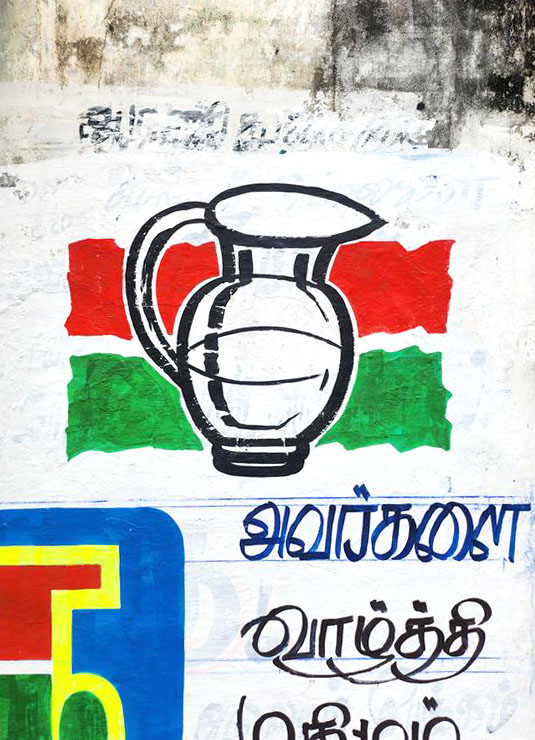
India’s situation differs in scale but rhymes in ways worth examining. Centuries of invasion and two hundred years of British administration produced an internalised sense that one’s own culture is inferior, embarrassing, best abandoned by anyone with aspirations to modernity and sophistication. The sacred becomes “mythology” and profound philosophical vocabularies become decoration. English becomes the language of intelligence while Sanskrit gathers dust.
And so a young man in Gokulam asks a white Australian whether he’s allowed to believe in Shiva.
Vani Shukla, Registered Level 3 Teacher, principal at Yoga Spirit in Adelaide, and president of the Hindu Council of Australia (SA chapter), knows this dynamic from the inside:
“When I was growing up, I used to receive my education in my local language, and when mixing with broader family I was looked down on because I could not speak English properly. The friends who spoke fluent English would try to make us feel inferior. I finally learned to speak English actually when I moved to South India for my yoga training in 2005. India is, you see, newly independent. It’s been only 75 years. People living now represent a new generation in free India, and that conditioning is still holding us back.”
An example is the widespread painting of knowledge systems as mythology, a comic-book literalism that was never the point. Vani notes: “Most people will not give it a second thought – and I also did not for a long time – but since I became more involved in my heritage I noticed these small things.”
Shiva as a blue man sitting on a mountain with a snake around his neck. Kali as a terrifying goddess with a necklace of skulls. Ganesha as an elephant-headed deity who rides a mouse. Taken as literal descriptions of beings who exist somewhere, these images become easy to ridicule, and educated Indians often overcorrect by dismissing the whole framework as embarrassing superstition.
The irony of yoga’s transmission to the West is almost comedic. A practice refined over millennia as a comprehensive system for human flourishing, encompassing ethics, physical discipline, breath regulation, sense withdrawal, concentration, meditation, and absorption into unified consciousness, is transported to Western cities by earnest seekers and within a few years reduced to workouts in heated rooms.
About ten years ago I was teaching at hot/power/flow studios and I was already feeling like “part of the problem” reflecting on the superficiality of the pursuit. Then one day after class a young guy approached me, flushed and enthusiastic, clearly new to yoga and having a wonderful time. He said to me excitedly “oh did you know that yoga actually has meditation as well?”
I didn’t know whether to laugh or weep! Here was the entire trajectory of modern postural yoga distilled. A tradition whose very purpose is the cessation of mental fluctuation, whose physical practices were understood as vehicle for merging with the vast Self, and we had managed to transmit it so incoherently that meditation registered as a surprising bonus feature.
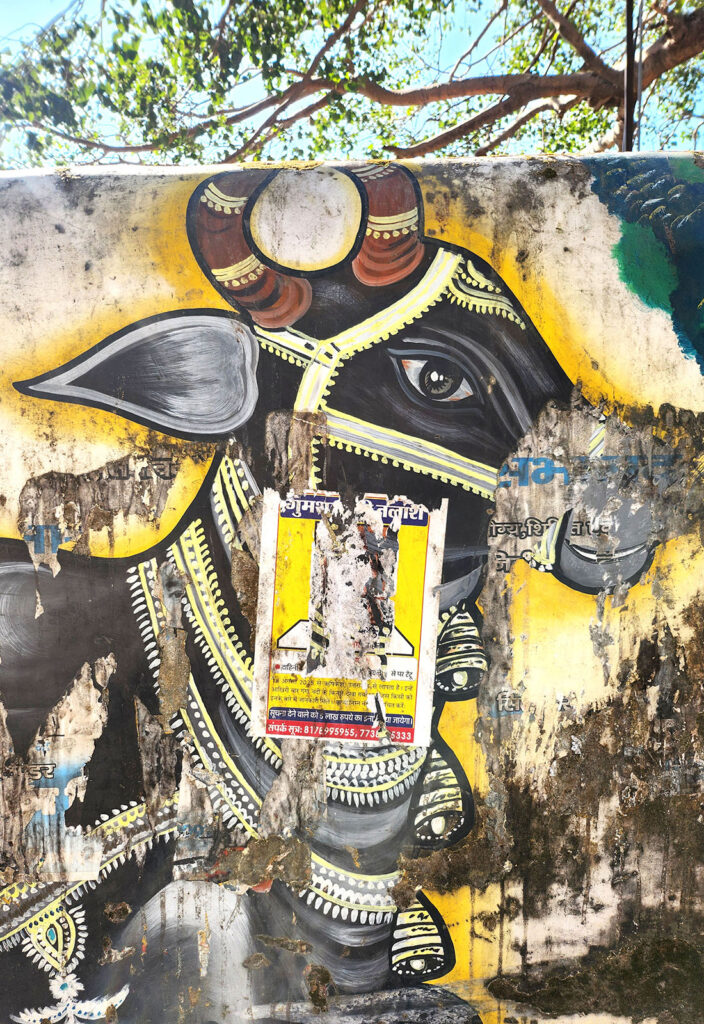
In the years that followed I recognised that yoga works miracles no matter the form, and that meeting cultures where they’re at is a beautiful service. There’s no time for snobbishness or performative hand-wringing – as long as we ensure contemplative depth is available to those who seek it. It is not a proud moment to find students glossing past yoga in search of meditation, turning to secular mindfulness programs or lite-Buddhism, or guided meditation apps with no cultural reference.
And in India itself? On the surface, Yoga and Āyurveda function as medical treatment, therapeutic intervention, even wellness tourism. In June last year I visited the National Institute of Siddha in Chennai, a government hospital and university established in 2005 that sees thousands of outpatients daily. It looks like any modern Western hospital: reception areas, consulting rooms, inpatient wards. But it operates entirely on Siddha medicine, the ancient Tamil healing tradition closely related to Āyurveda. Physical infrastructure of modernity housing knowledge systems that predate it by millennia.
The Ministry of AYUSH promotes yoga for diabetes management, stress reduction, immunity boosting. International Yoga Day draws massive crowds performing synchronised sūrya namaskāra in public squares. Prime Minister Modi hosts foreign dignitaries for yoga sessions as diplomatic soft power. All of which is fine as far as it goes, but the philosophical heart, enquiry into the nature of Reality, the direct investigation of what we actually are, often fades into the background, deemed perhaps too religious or esoteric – too unusual for global audiences.
That June visit was unusual for me. I have been to India ten times over the years, almost always for yoga: Mysore, Rishikesh, ashrams and schools. I had never spent more than a few hours in a large city. What struck me repeatedly was how saturated is the environment with metaphysical symbology. You expect it in ashrams, but here too – even more so in this thoroughly modernised, Westernised urban centre.
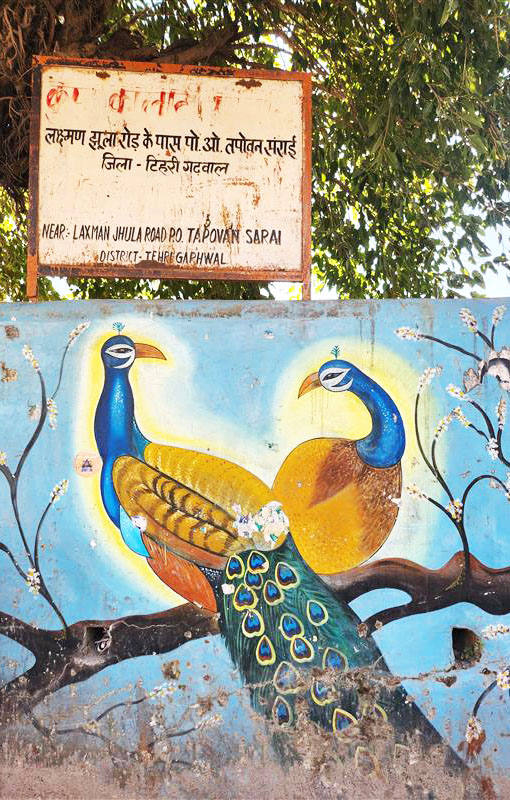
Peacock feathers everywhere. The peacock is India’s national bird, but also a profound symbol of asymptotic digression from singularity into multiplicity and back again – unity fanning out into a dazzling display of manifestation.
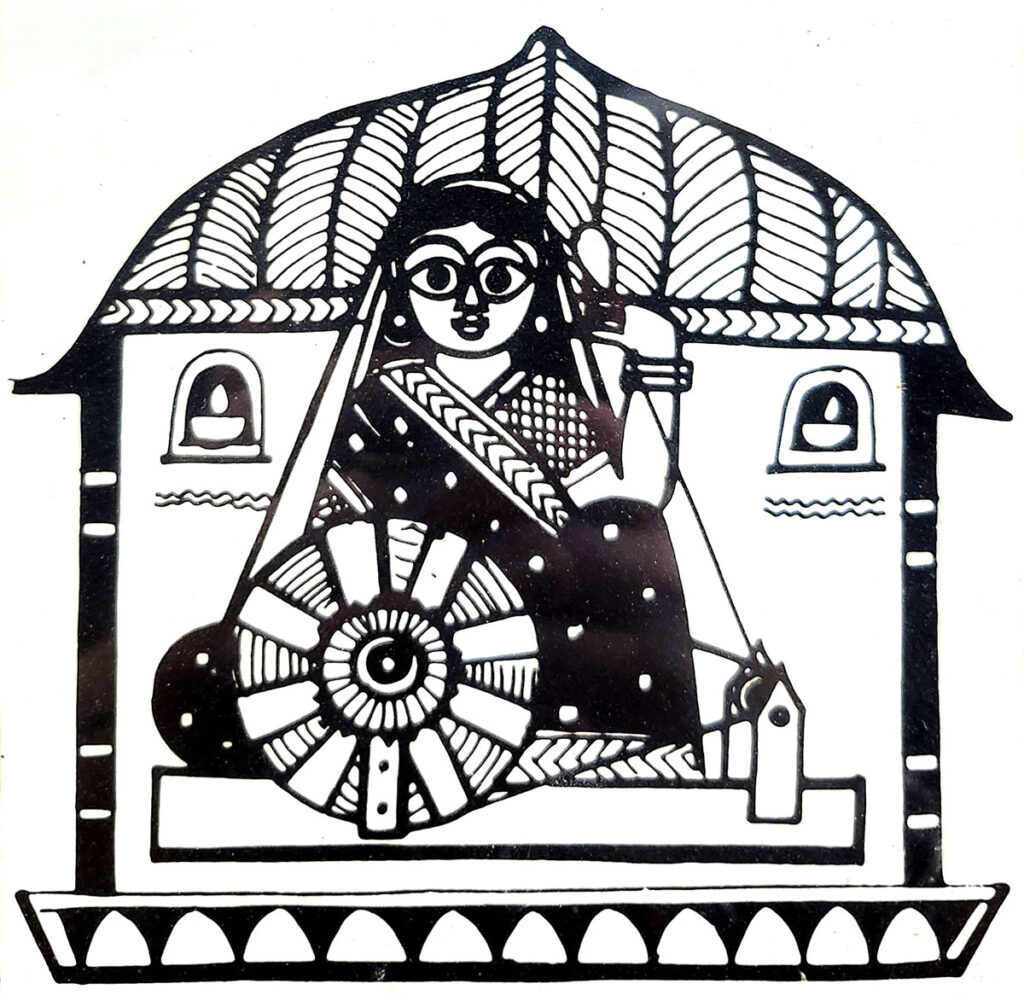
At the Gandhi Museum I stood before the carkha, the spinning wheel that became the emblem of Indian independence, and found myself thinking about bindu: the small point and the outer perimeter, the vortex, the spinning centre. Each atom, each corpuscle has its own suṣumnā, all dimensions present within a single point – what the Upaniṣads describe as smaller than the smallest and larger than the largest.
There is so much to be enjoyed for those who have eyes to see and for those with the luxury of inculcation, where reminders permeate daily life, architecture, national iconography, festival decorations, temple carvings, the henna patterns on a bride’s hands. All carry depth that Western seekers travel for days to access. Immersed in this experience, I thought “it would be a great shame if locals came to view this inheritance with embarrassment rather than reverence.”
Vani notes: “People live as karmayogins, with foundational practices like eating with the right hand (eating with the hands in general), and always greeting with both hands together. There are so many practices that people do unknowingly, because they are embedded in that world. Sometimes we are confused that it’s just cultural, that it has nothing to do with yoga, but most of the principles go very parallel to each other.”
The twentieth-century teachers who shaped modern yoga understood this. They inherited a tradition that had already undergone waves of reformation across millennia, adapting to new contexts while preserving essential principles. They were themselves reformers, finding ways to transmit practices refined in ashrams and royal courts to students with modern bodies and modern lives.
Vani takes comfort in this pattern: “How I console myself in this situation is usually I feel that yoga is a powerful practice and it has its own ability to survive and come back into its purest form again and again. If you see the history, before Sage Patanjali gave us the Yoga Sūtras, there was not even any written scripture or formalised way of telling how to practice yoga. It was just dictated by the teachers, gurus to disciples. And then time to time people came and tried to pull it all together. In the latest centuries we know that Shankaracharya made an effort to walk from Kanyakumari to Kashmir to synchronise and bring all these spiritual practices to one platform. This is just my belief that when there will be a very low stage of yoga practices, someone will come and rescue it.”
The question now is whether the current wave of transmission can hold that same intention. Organisations like Yoga Australia exist in part to support this work: getting education to people who are sincerely interested, negotiating the path between dogma and reduction.
We can offer fidelity to the full scope of yoga as a comprehensive technology for transformation that attends to the physical body and subtle bodies, extending into territories secular culture pretends do not exist. We can refuse the false choice between uncritical belief and dismissive materialism. We can honour the philosophical depth of the system without religious burden.
We can learn from Indigenous Australians who are doing their own work of reclamation, and from Indians who are rediscovering what was always right in front of them. And when a young man in Gokulam asks whether it’s acceptable to believe in these things, we can say yes. And perhaps that’s enough.
About the Author
Josh Pryor is the CEO of Yoga Australia, has practised Mysore style Ashtanga yoga for fifteen years, and presents at national conferences. He was a guest of Prime Minister Modi for International Yoga Day 2025.