Reflections on Two Years Sanskrit Study

Sanskrit holds the vibrational essence of yoga’s deepest teachings. In this reflection, Julian Singh shares how formal study transformed his relationship with the language, revealing it as a living tradition that bridges modern practice and yoga’s ancient roots.
How often do we chant or cue words like śānti, ahiṃsā or samādhi in class without pausing to ask what they really mean? If you’ve ever hesitated when a student asked, you’re not alone.
After twenty years of practice and ten of teaching, I had a recurring theme: familiar Sanskrit terms sounded powerful, yet I couldn’t always explain them with precision or in their original context. That ongoing curiosity — about śānti, karma, ahiṃsā and the many other words we use — was an ongoing call for further exploration.
That ongoing interest and some life circumstances, led me to start formal Sanskrit study. Over the past thirty months I’ve invested more than 2,000 hours in classes, grammar drills, vocabulary work and daily engagement with the Yoga Sūtras.
I’m hoping here to share some interesting things I’ve learned along the way, with other yoga teachers, regarding Sanskrit in Modern Yoga.

Acknowledgement
Firstly, I want to acknowledge that Sanskrit is a sacred and ancient language, carried forward by masters who dedicate their lives to learning, living, and transmitting it. My own studies are only a beginning, and I am deeply grateful to the teachers who have guided me and opened a doorway into this tradition.
Motivation and committing to study
There were three primary motivators that led to the decision to formally study Sanskrit. I sought to:
- Develop an accurate understanding of key terms and phrases in Modern Yoga,
- Build a more direct connection to the ancient roots of Yoga, and
- Start to learn about the vibrations of some of the Sanskrit sounds.
Formal courses provided the structure and grammar, and the guidance of experienced teachers — first Dr McComas Taylor at the Australian National University, and later Dr Antonia Ruppel, author of The Cambridge Introduction to Sanskrit — helped me take my first steps into understanding the technical rules, and practicalities.
Alongside this, I kept two personal projects running in parallel. Each day I worked on building vocabulary, adding a few new words and their roots to a notebook that gradually grew into a resource I could lean on.
At the same time, I began comparing translations of Patañjali’s Yoga Sūtras. With a fellow student, I read and reflected on one sūtra a day, across a range of respected translations. The variety across different well respected translations was revealing.
Together, these three efforts — structured study, vocabulary building, and comparative reading — fed into one another. They taught me that Sanskrit is about relationships and perspectives as well as the formal rules. They also showed me that translations are often interpretations shaped by context, lineage, and philosophy.
Example of variance in respected translations
One of the most striking lessons from my study has been seeing how widely respected translators can differ in their renderings of the same sūtra (connected line, stitch). These are not casual attempts — they come from some of the most respected teachers and scholars of yoga — yet they show clearly how much the translator’s perspective shapes what we read.
Take Patañjali’s Yoga Sūtras, Chapter 3, Sūtra 9:
vyutthāna-nirodha-saṁskārayor abhibhava-prādurbhāvau nirodha-kṣaṇa-cittānvayo nirodha-pariṇāmaḥ
Below are five translations, each by a highly regarded author who is an expert in Sanskrit:
- Sri Swami Satchidananda, The Yoga Sutras of Patanjali, p.169
“The impressions which normally arise are made to disappear by the appearance of suppressive efforts, which in turn create new mental modifications. The moment of conjunction of mind and new modifications is nirodha pariṇāmaḥ.” - Mukunda Stiles, Yoga Sutras of Patanjali, p.33
“From this, there is a true transformation of the mind as outgoing thoughts cease their former pattern of reacting to the appearance or disappearance of subliminal impressions. Instead, moments of restrained thought predominate.” - Marshall Govindan, Kriya Yoga Sutras of Patanjali and the Siddhas, p.132
“When the restless [movements] arising within consciousness are overpowered and subside [by the action] of restraint, there follows, in that moment, the development of the subconscious impression of restraint.” - B.K.S. Iyengar, Light on the Yoga Sutras of Patanjali, p.187
“Study of the silent moments between rising and restraining, subliminal impressions is the transformation of consciousness towards restraint (nirodha pariṇāmaḥ).” - Edwin F. Bryant, The Yoga Sutras of Patanjali, p.315
“The state of restraint, nirodha, is when there is a disappearance of outgoing [i.e. worldly] saṁskāras and the appearance of restraining saṁskāras. These emerge in the mind at the moment of restraint.”
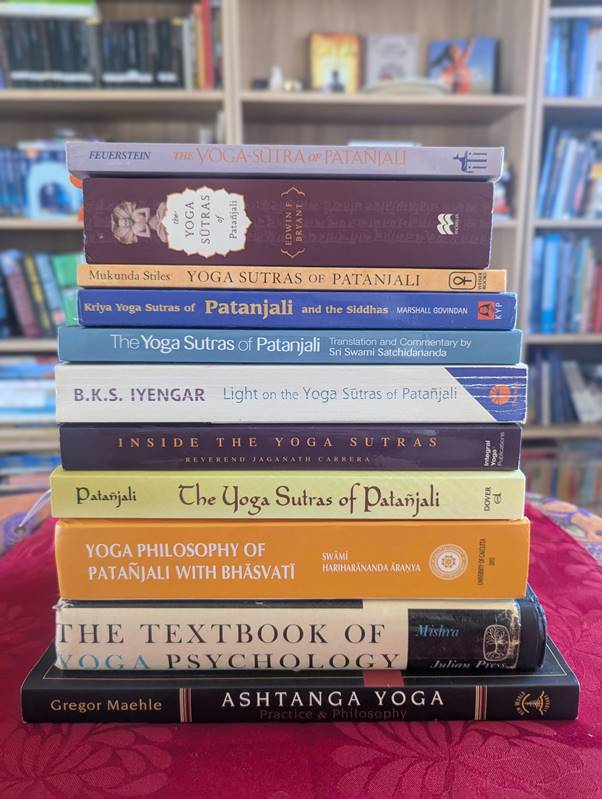
Each of these translations points in a slightly different direction: some emphasise suppression, others transformation, restraint, or silence. None are wrong, but each reflects choices made by the translator, shaped by their background, training, and philosophical perspective. The diversity in these translations is much wider when more of the sutras are connected. When reading the commentaries, a discourse on the translations themselves, the variance broadens even further.
This in part demonstrates how deep the sutras are, and how broad the various translations can be, remembering this is just one single line.
For yoga teachers, this is a reminder: there is often no single definitive English equivalent for a Sanskrit phrase. Every translation carries interpretation. When we quote or use these terms in class, we are passing on not just Sanskrit, but someone’s lens on Sanskrit. Recognising this helps us approach the texts — and our teaching — with greater humility and honesty.
With this in mind, and coming back to the broader contemporary focus of this blog, let me share some of the key insights and observations I’ve gathered from my own studies. Lessons that can support yoga teachers and anyone considering a deeper step into Sanskrit.
Observations and lessons to share – takeaways for yoga teachers
Even if you never plan to study Sanskrit formally, there are lessons from this journey that can shape the way we use the language in class. Here are some approaches found most helpful:
- Have confidence that Sanskrit is within reach. You don’t need to be a scholar to engage with the language. Reliable reputable teachers, online courses, and reference tools make it possible to start small and build steadily.
- Find a friend or group to study with. Having a study group makes all the difference. Questions get answered, motivation stays high, and you learn by hearing how others approach the same words.
- Work with words you actually use. Instead of trying to learn everything, focus on the terms that come up in your classes. Building a personal vocabulary of core words like yoga, śānti, or ahiṃsā creates confidence and immediate relevance.
- Always consider context. When quoting a passage, consider when it was written, who wrote it, and for what purpose. This shapes its meaning as much as the words themselves. I’m reminded of the mantra of one of my Sanskrit teachers ‘context is key!’.
- Be clear about your sources. Every commentary or translation reflects the perspective of its author. Tell your students which one you are using, so they understand the lens you are sharing through.
- Use Sanskrit thoughtfully. It is more than terminology – for many people it is a sacred tradition. Pronounce words carefully, explain them respectfully, and avoid using them as decoration.
Sanskrit can take a long time
For anyone considering more formal study, it helps to know that Sanskrit’s challenges lie well beyond memorising vocabulary or grammar charts. The script itself can take time to get comfortable with, especially conjunct consonants that look like unfamiliar tangles. Sounds merge through sandhi, so word boundaries blur and need to be carefully teased apart. Grammar adds another layer, with nouns and adjectives changing their endings depending on case, and sentences often omitting verbs entirely.
Even once you can read the forms, meaning remains fluid. A single word like dharma might mean law, duty, truth, or principle depending on context. Small prefixes, sometimes hidden within sandhi, can reverse or reshape meaning altogether. Most of all, context matters: a word must be seen within its line, the line within its text, and the text within its historical and cultural setting.
These are just some of the reasons why Sanskrit is often described as a lifelong study. It can be demanding, but each challenge eventually opens into a new way of connecting and understanding — which is why the effort can be so rewarding for yoga practitioners.
Continuing the journey
If you feel inspired to explore Sanskrit as a preliminary level (an introduction to an introduction), here are a couple of options:
- Sanskrit for Yoga Teachers workshop (in November, 2025): A practical, accessible way to explore pronunciation, key terms, and simple methods for weaving Sanskrit into classes with confidence.
- Sanskrit in Modern Yoga, my book, is now available as an advanced reader copy. It expands on many of the reflections here, with translations, and a technical breakdown of 108 key terms in yoga. This resource will continue to evolve over the coming years.
A closing reflection
Studying Sanskrit is a way of returning to yoga’s roots, one word at a time. The tradition’s terms are like doorways: each time we revisit them, they open a little wider.
You don’t need thousands of hours to begin. Start with one word, one verse, or one chant. With the right focus — choosing what supports your teaching and practice most — the rewards come quickly, and the connection deepens with every step.
About the Author
Julian Singh is a Registered Level 1 Teacher and has been practising yoga since 2002. He has been a certified Dru Yoga teacher since 2015. In 2022 he began formal Sanskrit studies, which led to the publication of his book Sanskrit in Modern Yoga – A Reference Guide in 2025.
Julian’s practice is focused on breathwork (prāṇāyāma), meditation, practical philosophy, and natural movement such as mindful walking and running. He explores the principle of tapas through endurance self-challenges (including a 100 km trail run, an Ironman, and multiple ultras). He has travelled extensively as a minimalist backpacker (three cumulative years) through India, Western Europe, and the Americas. He has lived and worked in London, NYC, Melbourne and now Canberra.