Yin and Restorative Yoga: Stillness, Surrender, and the Science of Safety

We live in a culture that glorifies motion. In our yoga practice we seek longer holds, deeper stretches, stronger shapes. Yet the true edge of yoga may be far quieter. It is found not in the stretch, but in the surrender. In recent years, Yin and Restorative Yoga have become two of the most visible “slow” practices in modern studios. Both appear still from the outside, both offer dim lighting, long holds, and silence, yet their inner landscapes differ profoundly.
Yin Yoga offers a purposeful engagement with discomfort. By applying gentle stress to fascia and connective tissue, it cultivates resilience and mobility. The subtle sensation of tension encourages tissue hydration and renewal, improving joint health and proprioception1. The nervous system is invited to stay with sensation, developing tolerance and awareness.
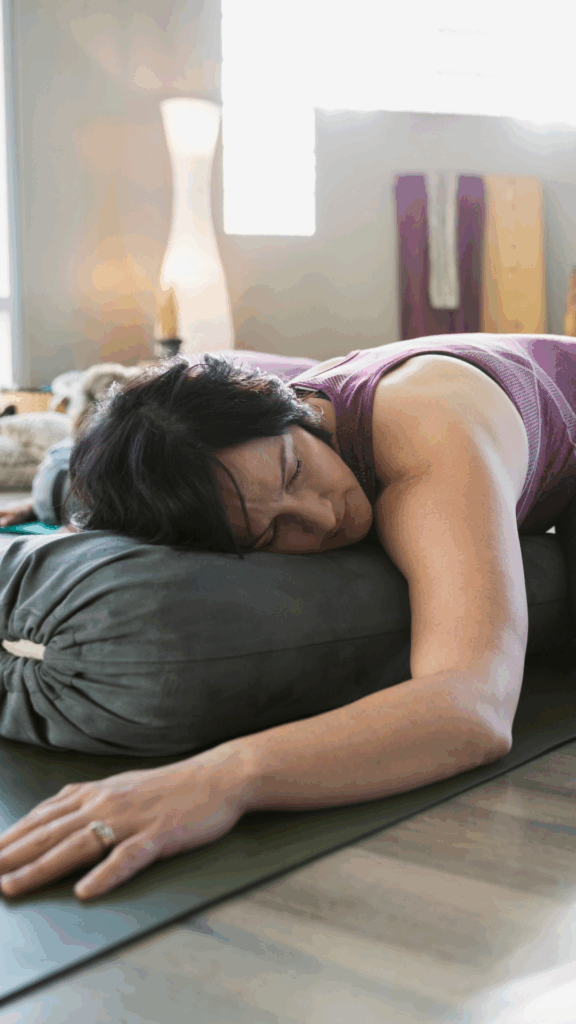
Restorative Yoga, in contrast, removes all physical effort. The body is fully supported with bolsters under knees and blankets under joints creating a sensory field of complete safety. This activates the parasympathetic nervous system, allowing the body to down-regulate from chronic stress.
Scientific research validates this ancient wisdom. Supported deep rest, such as Yoga Nidra, has been shown to increase heart rate variability (HRV) and reduce cortisol, both markers of nervous system balance and emotional resilience2 3. Restorative yoga interventions have also demonstrated improvements in metabolic syndrome, sleep quality, and immune function4.
Lineage and Language
Pioneers such as Judith Hanson Lasater, Uma Dinsmore-Tuli, Tracee Stanley, and Octavia Raheem remind us that rest is not passive, it’s a practice of profound listening.
While Yin asks us to meet sensation at the edge, Restorative asks us to soften the edge itself. Rooted in Patañjali’s call for mental stillness – the well-known citta vṛtti nirodhaḥ – Restorative Yoga becomes a living application of that sutra. Rather than retreating from the body, we enter it and reclaim our presence as medicine.
As in Ayurveda, balance is key. Yin stokes the gentle fire of tapas – transformation. Restorative nourishes ojas – the nectar of replenishment. Together, they form an ecology of resilience and rest.
Modern neuroscience supports what ancient yoga has always known: the state of our nervous system shapes our capacity for awareness. Practices that cue safety through slowness and support, activate the vagus nerve, regulating emotions, digestion, and hormonal rhythms1 2.
Rest is not a luxury — it’s a pathway to liberation.
Dr Gail Parker
Yoga Nidra: Rest as Conscious Awareness
In an age of overstimulation, Restorative Yoga offers an antidote, a way home to parasympathetic peace.
Yoga Nidra, often translated as “yogic sleep,” extends the philosophy of Restorative Yoga into the realm of conscious rest. While the body enters profound stillness, awareness remains awake, traversing layers of being (kośa-s) from the physical to the subtle. Unlike ordinary sleep, Yoga Nidra invites a meditative descent through these layers, offering access to parasympathetic regulation and the deep integration of experience.
Research supports this distinction. Yoga Nidra, as a key component of Restorative practice, has been shown to significantly increase heart rate variability (HRV) (a primary indicator of vagal tone and nervous-system resilience) compared to simple rest3. Studies in neuroscience confirm that slow, diaphragmatic breathing during Nidra modulates neural oscillations, synchronising brainwave patterns associated with emotional balance and calm4.
In the language of yoga, this is pratyāhāra, the conscious withdrawal of the senses, not as retreat but as return. Through Nidra, rest becomes an act of remembrance: remembering the body as safe, the mind as spacious, and awareness as whole. In this way, Yoga Nidra completes the ecology of rest that Yin and Restorative cultivate. This is not just a releasing of effort, but an awakening of presence within stillness.
By centering Restorative Yoga and Yoga Nidra within modern practice, we return to the original intent of yoga, not as performance, but as union through awareness. These practices remind us that the most profound transformation often happens when we are still.
Restorative Yoga as Somatic Education
For yoga teachers, Restorative practice is an education in nervous system literacy, in tone, language, and timing. It’s about co-regulation, not correction. Through this lens, we learn to hold space where every breath communicates safety and silence becomes a teacher.
Unlike Yin, where we meet sensation at the edge, Restorative dissolves the edge entirely. It teaches that healing happens not through effort, but through permission.
About the Author
Rocío Marte is a Restorative and Somatic Educator based in Brisbane, offering regular classes and Yoga Alliance/Yoga Australia–certified professional development programs. Her work draws from her mentors Judith Hanson Lasater, Uma Dinsmore-Tuli, Tracee Stanley, and Octavia Raheem, integrating somatic awareness, Yoga Nidra, and restorative practice to nurture deep rest and embodied presence.
Advanced Restorative & Somatic Facilitation Training
Brisbane | May–June 2026 | Three Weekends | 10:30 AM – 3:30 PM
A 50-hour in-depth professional training for yoga teachers and practitioners seeking to deepen their facilitation of rest, regulation, and embodied presence. Designed to unfold slowly with time to integrate, reflect, and embody the teachings between sessions.
References
- Clark, B. C., & Paoletti, S. (2019). Fascial system and yoga practice: The science of stretch and release. Journal of Bodywork and Movement Therapies, 23(3), 451–457. ↩︎
- Telles, S., Singh, N., & Balkrishna, A. (2012). Heart rate variability and oxygen consumption during Yoga Nidra practice. Indian Journal of Physiology and Pharmacology, 56(3), 273–278. ↩︎
- Zaccaro, A., Piarulli, A., Laurino, M., Garbella, E., Menicucci, D., Neri, B., & Gemignani, A. (2018). How breath-control can change your life: A systematic review on psycho-physiological correlates of slow breathing. Frontiers in Human Neuroscience, 12, 353. ↩︎
- Kiecolt-Glaser, J. K., Christian, L., Andridge, R., Hwang, B. S., Malarkey, W. B., & Glaser, R. (2015). Adiponectin, leptin, and yoga practice: Restorative yoga intervention for metabolic syndrome. The Journal of Alternative and Complementary Medicine, 18(7), 662–668. ↩︎
- Boyadzhieva, A., & Kayhan, E. (2021). Keeping the breath in mind: Respiration, neural oscillations, and the free energy principle. Frontiers in Neuroscience, 15, 647579. ↩︎
- Folschweiller, S., & Sauer, J. F. (2023). Behavioral state-dependent modulation of prefrontal cortex activity by respiration. The Journal of Neuroscience, 43(26), 4795–4807. ↩︎
- Telles et al., 2012, 273-278. ↩︎
- Zaccaro et al., 2018, 353. ↩︎