Yoga for People Experiencing an Eating Disorder

Eating Disorders are serious mental health conditions that involve an unhealthy preoccupation with eating, exercise and body weight or shape, affecting approximately 1.1 million Australians. Young people are disproportionately impacted, with evidence suggesting that rates of eating disorders among children and teenagers are growing.
Treatment for EDs typically involves a multidisciplinary team, including medical, nutrition and mental health professionals. This reflects the wide-ranging physical, psychological and social impacts of these conditions. However, many people with lived experience of EDs report that treatment doesn’t always address aspects of recovery that matter most to them.
Individuals often describe feeling disconnected from their bodies and struggling to cultivate a more compassionate relationship with their bodies and movement. They report that treatment can overlook the embodied experience of living with an eating disorder and the desire to find safe supportive ways to move or engage with exercise. These are areas where yoga may be uniquely placed to support people with eating disorders.
How can Yoga assist recovery from eating disorders?
Yoga understands the body as a multi layered system rather than separate parts so has the scope to assist those looking for a person centred and embodied approach.
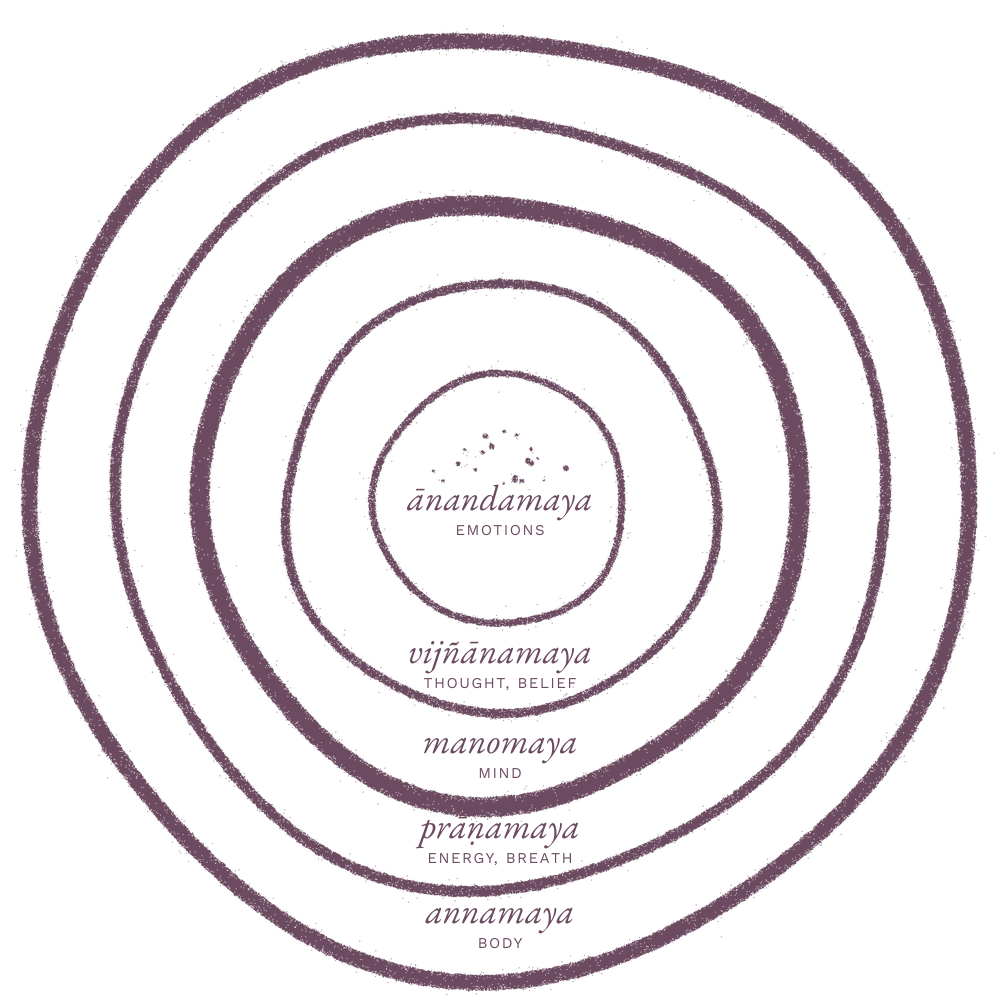
The Pancamaya model (from the Tattiriya Upanisad) presents five layers that the human form consists of – the physical body, mind, energetic body, emotions and thoughts/beliefs. All five aspects of the human system are profoundly influenced by the integrative approach of yoga practices.
Eating disorders are characterised by an internal system that presents imbalance in one or more of these five layers. Whilst the body layer may most obviously show signs of distress, other layers such as mind and emotions will also be disrupted. In Yoga class, this might look like over-exercising by pushing the body through challenging practices as well as over frequency of class attendance. It may be using a heated yoga environment to reduce weight.
The ‘five layers’ model can be valuable for Yoga Teachers and Yoga Therapists who come across students who present with eating disorders. According to yoga philosophy, each of the five layers can be directly influenced through practice on the mat; however, the mental-emotional layer (manomaya kosha) frequently guides and shapes the experience of the others.
As a reflective practice, yoga can offer the space to ‘see’ in a different light once the mind agitation and overthinking is reduced through embodied movement. Practising yoga moderately with breath awareness, frequent rest and space between postures may move the mind towards the nirodaha (enveloped) state where it can hold a stable, internal orientation rather than one of distraction and agitation.
Through engaging the mind, there is then opportunity to address eating disorder related thoughts and beliefs (through the vijnanamaya layer) and to question and orient towards shifting the negative patterns (samskaras) that might present. Of course, this is an ongoing process but one that the practice can support if done regularly over time.
Are there particular practices we should offer students who we know are in recovery with an ED?
Are there ways we can tailor yoga practice that can support positive embodiment and interoception while avoiding risks associated with compulsive movement and other risks?
These were some of the questions posed by our research team as we set out to investigate how Yoga could be tailored as an adjunct mind-body therapy to enhance recovery and wellbeing.
A set of guidelines were developed through talking to people with lived experience of eating disorders, their carers, along with clinicians and yoga teachers /yoga therapists working with people with eating disorders.
The guidelines include the following:
Favour:
- slow and gentle practice where the participant is not ‘competing’
- offering poses in their simplest form (along with modifications and rests)
- conscious breath awareness and regulation in line with movement
- offering trauma informed language that emphasises safety and choice
- room temperatures between 21-24 degrees
Avoid:
- fast, vinyasa flow styles of Yoga
- heated or gym style environments that may emphasise competitiveness
- large group classes
The Trial Protocol – What Did it Look Like?
Drawing on these guidelines and an understanding of the yogic view of disease, our research group then developed a therapeutic yoga program for individuals experiencing an eating disorder. We completed a small ‘proof of concept’ study to understand how the yoga program was experienced by young people in treatment for an eating disorder, supported by a carer. Participants were under the care of a doctor, dietician and psychologist and approved as medically ready to take part in the program. Each group took part in a series of 8 x 50 minute, once a week group classes along with a personally designed Yoga Therapy practice for home.
As the Yoga Therapist, I met initially with each participant for 60 minutes and designed the short, simple breath-led home practice to be completed daily. The practices ranged from 15-25 minutes in length and included breath led movement, and some appropriate pranayama techniques according to the needs of the individual.
The combination of the home practice and weekly group class was the basis of the study.Careful presentation of the group classes was considered through:
- Specific trauma-informed and body positive language
- Mats laid out in a circle formation, with participants facing inwards towards each other. Relaxation music and soft lighting to create an inviting and safe space. No mirrors.
- Soft props such as thick mats, bolsters to sit on and blankets to put underneath for extra cushioning in lying postures.
- Appropriate teacher presentation – no tight fitting or body revealing clothing
- Teacher welcoming and chatting with each participant and carer on arrival to gauge where they are at on the day.

The Yoga protocol was developed based on a breath-centred approach derived from Krishnamacharya lineage. Both breath and movement practices were simple as most participants had no experience of yoga. Conscious breath was used to positively reorient the flow of prana (the life force energy). This was intrinsic to ‘linking’ mind and body into a connected experience.
The yoga practices encompassed specific standing, seated and lying postures that were deemed suitable for the participants (refer to attached outline). This cohesive flow of class structure offered a seated start and introduction of a theme, connecting with breath, then beginning simple asana from standing then to lying/seated with space to rest in between transitions. The practice was completed with savasana and guided relaxation.
As the energy of participants could be low due to lack of nutrition and nourishment, the breath was also a way to subtly increase energy in the system without over exertion. Energetically I understood there to be a twofold approach required because of the diversity of eating disorders presentations.
- A brahmana approach or a focus on ‘adding’ to the system. Increase capacity and energy (particularly in the mind) through engaging the body in steady, specific postures. Shifting a pattern of being ‘stuck’.
- A langhana approach through ‘pacifying’ a depleted body and overactive mind via more static and slower moving postures – minimal movement with maximum effect.
The practices included a theme or reflection that came from the philosophical learning of the Yoga Sutras of Patanjali, specifically the niyamas (personal disciplines). These can support an individual to address unhelpful thoughts and patterns – for example, samtosa speaks to cultivating contentment and svadhaya to reflecting on actions and beliefs.
Underpinned by positive embodiment, the overall goals of the Yoga protocol were to:
- Take the participant to an internal experience of feeling calm.
- Understanding how to nurture the body and create positive experience of self through practice.
- Form a positive relationship with exercise/body movement.
For me, the practice design was all about the components complimenting each other. The combination of the physical structure of practice – inviting the body and breath to move in a new way – married with introducing psychological concepts that pertain to us as humans. Giving space to reflect on all of this in an inviting and relaxed form allowed for the experience to sink deeply.
Observing how relaxed participants were after practice emphasised the impact of instilling a calm state of mind – which in turn may have offered an opportunity for new patterns of thought and behaviours to arise.
Research Findings.
The participants described yoga as feeling gentle, safe, and different from the pressured or exhausting exercise they had experienced in the past. They described feeling calmer, more connected to their bodies, and better able to manage difficult emotions. Carers were surprised to find the sessions also helped them feel more grounded and supported.
Although there was initial hesitation for some around body comparison and being in a group with others also struggling with an eating disorder, most found there was a shared understanding around practicing with others with similar experience. The noncompetitive environment allowed a focus on individual breath and movement to be developed.
Off the mat benefits included participants having better emotional regulation and witnessing thoughts arising without becoming caught in them. The use of breath techniques in stressful outside situations was another benefit. The relationship between carer and participant was also mentioned as being enhanced through sharing the group classes. Often this was a parent/child relationship that may usually experience conflict through the daily management of the eating disorder.
Conclusion
As a yoga practitioner working with people with eating disorders, there is much to be considered and much that can be offered. An empathy or awareness towards the other’s experience is key. The Yoga Sutras offer us the concept of pratipkasa bhvanam – to take the opposite viewpoint. This wisdom asks that we consider the other, their experience and the potential effect of what we offer. This is the essence of a therapeutic yoga approach – offering steps towards wellness in the most suitable way.
Preliminary findings of the research suggest that, when delivered in an ED-informed and trauma- informed manner, therapeutic yoga may be experienced as a safe and acceptable adjunct to standard ED treatment. Rather than replacing established interventions, yoga may complement existing approaches by addressing aspects of recovery that consumers and carers described as insufficiently met elsewhere, particularly embodied experience, emotional regulation, and family support. A practice supporting recovery of the whole system.
About the Authors
Words by Jill Harris (Kyo Yoga & Healing) and Melissa O’Shea (Deakin University).
Jill Harris is a Senior Teacher and Yoga Therapist with Yoga Australia, involved in implementing yoga as therapeutic intervention in research trials with Deakin University. She also runs group classes and 500 hour teacher trainings in the Krishnamacharya lineage.
Melissa O’Shea is a Professor of Psychology at Deakin University and Clinical Psychologist. She completed her yoga teacher training in 2019 (YTT 500 hours) and her research has explored the benefits of therapeutic yoga as an adjunct to psychological treatments.