Yoga Is Not a Religion

Why Yoga Is Mistaken for a Religion
Yoga is often asked to answer a question it never set out to answer, whether it is a religion. The question is understandable. Yoga emerged in ancient India and reaches us through philosophy, contemplative practice, sacred language, symbolic imagery, mythology, and, at times, ritual forms that can appear religious to a modern Western eye. When encountered without context, these elements can easily lead people to assume that yoga is simply another religion, or that participation in yoga requires adherence to a particular belief system.
Yet this conclusion is too simplistic. To call yoga simply a religion is too blunt, just as calling it ‘just exercise’ is too shallow. Yoga is better understood as a disciplined path of human development arising within a larger philosophical and cosmological vision of life.
Part of the confusion lies in the categories we use. In the modern West, religion is often understood in terms of creed, institution, dogma, and exclusive belief. Yoga does not fit neatly into that picture. It is not, in its essence, a creed to which one merely assents, nor is it reducible to membership in a single religious community. It is better understood as a philosophy, a methodology, and a discipline of transformation. It offers an account of suffering, the instability of mind, the possibility of inner freedom, and the refinement of body, breath, attention, and awareness. In this sense, yoga is not a religion in the narrow Western sense, though neither is it spiritually rootless.
Yoga is not a religion, but a systematic and exact science for body, mind, and soul.
— Swami Rama
Sanātana Dharma
To understand yoga more fully, we need a larger view, Sanātana Dharma, the wider sacred and philosophical vision of reality from which yoga emerges. Sanātana Dharma may be understood as the eternal order, the deeper intelligence, lawfulness, and harmony that underlies the cosmos, human life, and inner development. It is less a religion in the narrow Western sense than a way of understanding life itself.
Within this wider world of classical Indian thought, the six orthodox, or āstika, systems of philosophy are described as orthodox because they accept the authority of the Vedas, even though they interpret that authority differently. These six are Nyāya, Vaiśeṣika, Sāṃkhya, Yoga, Mīmāṃsā, and Vedānta.
They do not all teach the same thing, nor do they arrive at identical conclusions. Rather, they may be understood as distinct disciplines or philosophical languages through which many of the same fundamental questions are explored.
Together, they belong to a shared civilisational matrix in which the Vedas serve as a foundational point of reference for inquiry into reality, order, duty, consciousness, and liberation. Yoga, then, is not an isolated self-help system floating free of roots. It belongs to a much wider sacred and philosophical world.
Yoga and Cosmology
This is why the language of cosmology is often more helpful than the language of religion. Yoga belongs to a worldview. It sits within a larger understanding of the human being in relation to nature, consciousness, moral order, and ultimate freedom. In this broader Indian context, yoga reaches well past flexibility or stress reduction, though it may include both. It is part of a vision of life in which body, breath, senses, mind, conduct, and knowledge are interconnected and capable of refinement.
The Vedas matter here as foundational sources within the intellectual and sacred world from which the orthodox systems emerge, more than ‘scripture’ in a narrow Western sense. In this context, yoga is one path among several, not the whole of the tradition. The Bhagavad Gītā is especially important because it presents multiple paths, including action, knowledge, and devotion, and situates yoga within a larger vision of self-realisation and right living.
This wider background helps us see yoga as part of a broader account of human life and spiritual maturation, larger than postural practice and larger than meditation alone.
Myth and Meaning
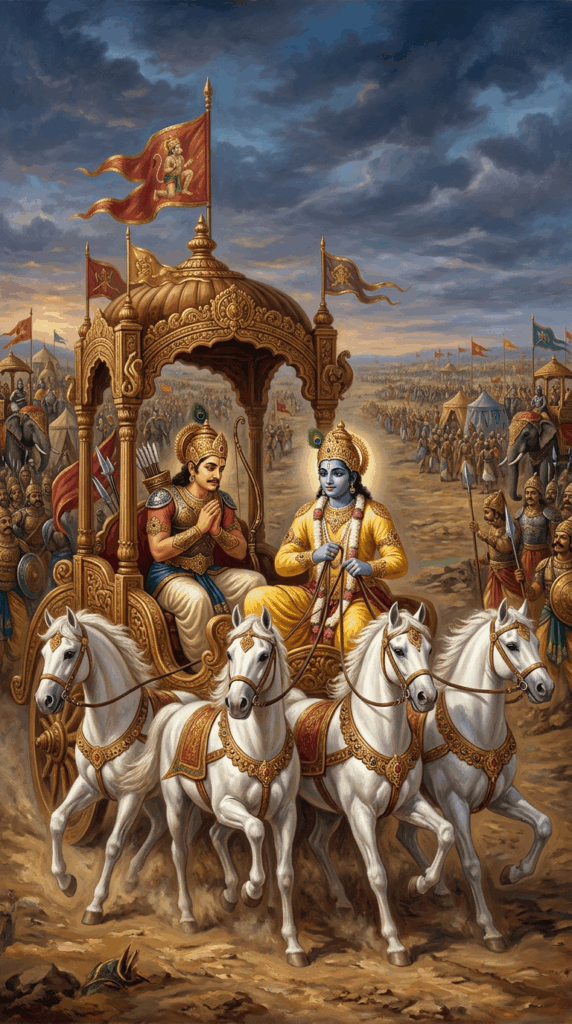
Mythology has traditionally helped communicate this wider vision. This is where Joseph Campbell can be useful for modern readers. He helps us see that myth is one of the ways human beings express and transmit cosmology, far more than fantasy or superstition. In the Indian context, sacred stories, deities, and symbols often carry cosmological, ethical, and psychological meaning. Campbell is not a traditional authority on Yoga or Vedānta, but he can serve as a bridge for readers who need to recover the idea that myth can be a vehicle of truth rather than the opposite of philosophy.
Carl Jung offers a different but equally useful caution. He is often paraphrased as saying that yoga is ‘not for Westerners’, but his concern was more subtle. He did not dismiss yoga as false. Rather, he warned that Eastern disciplines could be imitated superficially by seekers who lacked the philosophical and psychological framework to integrate them properly. Whether or not one agrees with Jung’s distinctions between East and West in full, his warning remains relevant, for sacred disciplines lose coherence when borrowed in fragments and stripped of context.
Yoga as Philosophy and Method
To move beyond these simplifications, it is important to distinguish yoga as philosophy from yoga as method. As one of the classical darśanas, yoga offers an account of the human problem, the instability of mind, the force of conditioning, the mechanisms of suffering, and the possibility of freedom through disciplined practice.
But yoga is also a practical methodology. Through the framework of Aṣṭāṅga Yoga, the practitioner works progressively with ethics, self-discipline, posture, breath regulation, sense withdrawal, concentration, meditation, and absorption. In this progression, the practices of yoga prepare the body and steady the mind. They are not ends in themselves. They refine the human instrument and make it fit for deeper inquiry.
This is why yoga can rightly be described as a path of human development. It works progressively through body, breath, senses, mind, and awareness. It does not isolate the physical from the psychological, or the psychological from the spiritual. Swami Rama’s contribution is important here, because he presents yoga as a discipline for the fullest development of the human being rather than the possession of one religion. Regardless of one’s faith, culture, or tradition, yoga may be engaged as a means of refining universal human capacities, steadiness, attention, conduct, insight, and consciousness.
When Context Is Lost
Part of what clouds modern yoga teaching is the loss of context and method. Without a clear understanding of where yoga sits within the wider landscape of Indian philosophy, practitioners can easily conflate the classical discipline of yoga with the many ritual, symbolic, astrological, medical, tantric, and devotional forms that surround it.
Astrology, Jyotiṣa, Āyurveda, goddess practices, and other associated systems may each have their own integrity and value, but they are not identical with yoga, nor should they obscure its methodology. When too many elements are brought together without sequence or discrimination, the path becomes blurred. This is not to diminish the wider tradition, but to insist that clarity of method matters.
For many practitioners, the soundest starting point remains the disciplined framework of the Yoga Sūtras, the steady refinement of conduct, body, breath, mind, and meditation through the Aṣṭāṅga system. A broader view should give context, not confusion.
The Place of Method
This is also why yoga teaching requires more than inspiration or eclecticism. It requires method. A sound pedagogy should help students follow the path in an ordered way, remain with it long enough for it to work upon them, and gradually become fit for its classical fruits. If yoga is to remain a true discipline rather than a loose spiritual collage, teachers and teacher trainings alike must recover the importance of sequence, structure, and philosophical clarity.
The classical goal of Yoga, in the Patañjali tradition, is samādhi. This is a profound integration, stillness, and absorption culminating in the cessation of the fluctuations of mind, well beyond calmness or relaxation. Yoga is therefore a precise and disciplined methodology that works upon the body-mind in an ordered way rather than a loose collection of spiritual ideas. It offers a systematic path, one that refines conduct, steadies the body, regulates the breath, gathers the senses, focuses attention, and prepares the mind for deep meditation.
In this sense, yoga is complete as a method. It does not need to be confused with the many adjacent systems, symbols, or practices that may sit around it in the wider Indian tradition. Its strength lies in its coherence. It gives the practitioner a clear path to follow, and it is this methodological clarity that is often lost in contemporary teaching spaces.
Yoga and Vedānta
Vedānta, another of the classical darśanas, may be understood as a wider philosophical horizon that some practitioners approach once the mind has been sufficiently prepared through yoga. If Yoga offers the methodology, Vedānta opens the way to deeper inquiry into the nature of the Self and reality. In this sense, the two need not be seen as separate or opposed. Yoga refines and steadies the body-mind through a disciplined path of practice, and that prepared mind may then become available for subtler knowledge. The essential point, however, is that yoga is already a coherent and complete methodology, with its own integrity, process, and goal. It is not a religion, but a systematic way of inner development.
Modern Vedic teachers have also helped articulate this larger picture in contemporary language. Maharishi Mahesh Yogi presented meditation as a means of relieving stress and restoring balance and, beyond that, as part of a far wider Vedic vision of consciousness, natural law, and human development. His contribution deserves respectful attention. While the full scope of that teaching may not be easily grasped in our present time, it reminds us that yoga and meditation were never intended to remain at the level of self-improvement alone. They belong to a much larger vision of life, reality, and human possibility.
Conclusion
Perhaps this is the deepest reason yoga has endured across time, culture, and context, that it speaks to the whole human being. One might reasonably argue that yoga is among the most holistic, refined, and complete systems of human development the world has produced. Few traditions offer such an integrated vision of life, addressing ethics, conduct, body, breath, senses, mind, attention, contemplation, and liberation within a single coherent framework.
Yoga does not isolate the body from the mind, the mind from character, or character from consciousness. It offers a whole vision of human possibility. For this reason, yoga is best understood not as a religion in the narrow and sectarian sense, but as one of humanity’s great paths of inner development, self-knowledge, and freedom.
Rather than being a religion, yoga is best understood as a methodology for self-awareness, inner refinement, self-mastery, and ultimately liberation.

Editorial Summary
Yoga is often mistaken for a religion because it comes to modern readers clothed in sacred language, symbolic imagery, mythology, ritual forms, and philosophical depth. Yet this article argues that such a conclusion is too simplistic. Yoga is better understood not as a religion in the narrow Western sense, but as a disciplined methodology of inner development arising within the wider philosophical and cosmological framework of Sanātana Dharma.
The article situates yoga within the six classical darśanas of Indian philosophy and explains why a broader understanding of Indian thought helps clarify yoga’s place without collapsing it into the whole of the tradition. It argues that one of the major problems in contemporary yoga culture is the loss of methodological clarity, since yoga is often mixed indiscriminately with adjacent systems such as astrology, Jyotiṣa, Āyurveda, tantric symbolism, and devotional practices, leaving students confused about what yoga is.
Returning to the Yoga Sūtras and the Aṣṭāṅga framework, the article reasserts yoga as a coherent and systematic path whose classical aim is samādhi. Vedānta is introduced as a wider philosophical horizon that may open once the mind has been prepared, rather than a replacement for yoga. The article concludes that yoga is not a religion, but one of humanity’s most holistic and refined systems of inner development.
A Short Glossary
- Sanātana Dharma – often translated as “the eternal dharma” or “the eternal order”, the wider sacred, philosophical, and ethical framework of Indian tradition within which yoga arose.
- Dharma – order, duty, truth, or living in alignment with the deeper laws of life.
- Vedas – the oldest sacred texts of the Indian tradition, foundational sources of knowledge and authority for the orthodox schools of philosophy.
- Darśanas – the classical philosophical viewpoints or systems of Indian thought, of which yoga is one of six.
- Samādhi – deep meditative absorption or integration, in the Patañjali tradition the culmination of the yogic path.
- Vedānta – one of the classical darśanas, based on the Upaniṣads, concerned with the nature of ultimate reality and liberation through self-knowledge.
- Mokṣa – liberation or freedom, in Vedānta the freedom found through knowledge of one’s true nature.
- Brahman – the ultimate reality in Advaita Vedānta, limitless, non-dual, and the ground of all existence.
About the Author
Avril Bastiansz is a Melbourne-based yoga and Vedic meditation teacher, counsellor, psychotherapist, and clinical nutritionist. She is the founder of Become YOU and The Renaissance Woman’s Circle.
With over a decade of experience, she weaves together traditional yoga philosophy and modern therapeutic practice to create safe, transformative spaces for students. Avril is committed to preserving depth, methodological clarity, and integrity in the teaching of yoga today.