Strength Through Mantra

Ancient, Hardwired Pathways to Transform Your Inner Landscape
Jodie Lunn, Co-Founder of Abhyāsa Yoga speaks with Nitya Mohan of Svastha Yoga, daughter of renowned yoga masters A.G. and Indra Mohan, about the profound role of sound and mantra for mental, spiritual and physical health.
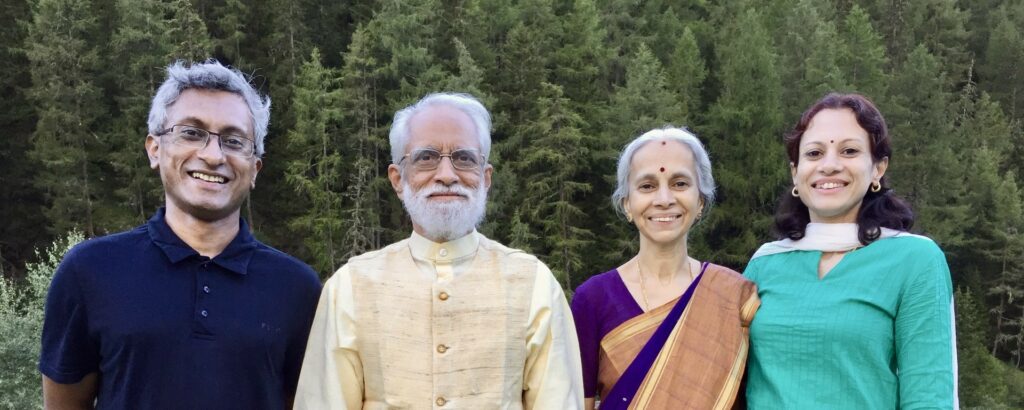
Jodie: Abhyāsa Yoga is honoured to be hosting the first of your global workshops on cultivating inner strength and resilience using mantra. What is so unique about mantra as a tool for good health?
Nitya: A mantra is essentially a sound. Sound forms one of the deepest links between body, breath and mind. The vibrations of sound are real and felt in the body, the breath is the primary support for sound production and sounds are deeply connected to emotional states through pitch and frequencies.
This is in our experience. If you repeat the name of a person whom you really love, can you separate the sound of the word, from the feelings it evokes in your body, breath and mind? Inversely, if someone is terrified of something, can they separate the feeling from the sound if they hear or say the word? The shift in the breath, the tensing of the muscles and the emotional responses are instant. The Yogasūtras in chapter 3, (III.17) say śabdam=word or sound, artham=object or meaning, pratyayam=mental movement or impression related to the word, these three are stored and recalled together always.
Hence, the easiest way to shift any unhealthy habits and create positive healthy patterns or saṃskāra-s (stored impressions) in body and mind is through mantra-s and sound.
To go deeper, ancient Vedic literature uses this word śabda prāpañcam, meaning a world of sound and says all thoughts are inner sounds. My world is my mind, and my mind is sound. To change my outer and inner world, I need to change my inner sounds. And that is what a mantra is.
My world is my mind, and my mind is sound. To change my outer and inner world, I need to change my inner sounds.
Jodie: How can something as simple as chanting a mantra strengthen the body, our physiology and psychology?
Nitya: There exists a bidirectional pathway of influence between sound and our body, breath and mind. We can work with the aspects of sound production, voice quality, resonance etc. to positively impact our body states. We can improve our physiological and respiratory health when we combine mantra-s properly with the effort of the breath in āsana and prāṇāyāma (prāṇāyāma in traditional texts is actually defined with a mantra). When we use mantra-s with the range of musical tones, scales and bhāvanā-s (inner connections and affirmations) we can bring steadiness and emotional balance to the mind. In truth, no other tool can effortlessly bring together all aspects of our wellbeing.
Jodie: What are the origins of mantra? What relationship do they have to Hinduism?
Nitya: There are two roots for the word mantra. One is mananāt trāyate iti. That which protects me when I repeat it. The second mantārāṃ tārayati iti mantra. That which helps me cross over the mind to get to the ultimate.
What do we need protection from? Often from our own mind! A mantra is to be developed as an inner source of strength within us. A tool that gives us the ability to step back safely, not only from outside disturbances but often from the chaos of our mind itself.
Mantra-s are popular in Vedic literature but actually sound in the form of sacred syllables or words are found in ancient literature across religions, be it in the Gospels, Mayan, Sufi texts or Aboriginal traditions.
In order to really gain the benefit of mantra-s, it is important to deconstruct and understand the true purpose of mantra-s as sound (in whatever language they may be) and work with a variety of words, tones, verses, songs. It is a truly universal tool, need not and should not be restricted by any belief systems.
Mantra-s are recognised as cognitive tools in the Yogasūtras, to help break negative thought patterns, to enable us to recognise, reflect, and redirect our thinking in the desired direction.
Jodie: Is there a difference between saying a mantra versus an affirmation?
Nitya: Yes because a mantra should be combined with an affirmation. What we understand as an affirmation is called bhāvanā in traditional texts. This word comes from the root bhū, bhav – to be. What I AM in relation to something is my bhāvanā. This is a combination of my connections, affirmations and intentions. When I combine a mantra with a chosen bhāvanā that is appropriate for my needs, it has the possibility to truly transform me from within.
This will lead to very interesting questions on how do I know if a mantra is appropriate for me. We all know each of us are unique, which is why Krishnamacharya’s approach to āsana-s was to do what is suited for the person. This holds good for mantra work as well. We must choose and individualise mantra-s based on age, physical capacity, emotional needs, breath and safe voice range.
Jodie: What does yoga tell us about the relationship between cultivation of positive emotions and sound?
Nitya: In the Yogasūtras, mantra-s are mentioned in several sūtra-s across the text. In fact, the practice of svādhyāya (root meaning sva adhi ayanam – that which takes me closer to my self) is defined as mantra japa (repetition and recall). Mantra-s are recognised as cognitive tools in the Yogasūtras, to help break negative thought patterns, to enable us to recognise, reflect, and redirect our thinking in the desired direction.
Jodie: Why would you recommend a yoga teacher or therapist cultivate a mantra practise?
Nitya: Honestly, not just a yoga teacher or therapist, but every individual, who is interested in having an integrated tool for their wellbeing, should cultivate a mantra practice. A mantra should not be perceived as a Sanskrit chant alone but understood in its innate form as a sound that has the power to influence body, breath and mind. As a yoga teacher or therapist, learning to teach by combining mantra-s in āsana, prāṇāyāma and meditation will enable you to expand your offerings with depth and clarity and address the wellbeing of your students more holistically and effectively.
Jodie: What is the biggest benefit you witness in people when they start to develop a relationship with their own voice?
Nitya: A whole range of benefits, starting with psychological shifts stemming from better emotional management, steadier self-perception and confidence, release of chronic physical tension, much better sound with less effort physically, to name a few. Our voice is the deepest part of our identity. Voices are as distinctive as our faces, no two voices are ever exactly alike. Our voice is both a psychological and physiological identity signal. Vocal anatomy is only partly genetic, vocal habits and how we sound is mostly learned and habitually shaped. What I have seen is, if someone develops a better relationship with their voice, it supports changes in many other dimensions.
Jodie: Can you share a mantra that calms and strengthens the mind.
Nitya: Hard to choose one! There are so many, ranging from a single word to a few words to verses. I will share one example. Jñānāya hṛdayāya namaḥ. Jñāna means knowledge and here my true nature which is rooted in wisdom and light, hṛdaya means heart space (the Upaniṣads speak of an exact location of a centre within the chest region they called hṛdayam), this is the space from where I feel the strongest connection with the I feeling, also where I experience my emotions from within me. Namaḥ is a word that connects me with a feeling of awe, humility and awareness to this wisdom that resides in my heart. We can use this mantra separately or along with nyasa-s, which are special placements of intention in the body with the breath, to bring in a positive pathway of connecting to my true self.
Workshop Details: Strength Through Mantra with Nitya Mohan
24th – 26th July 2026
Ballina, New South Wales
Day 1: Body and Mantras
Day 2: Breath and Mantras
Day 3: Mind and Mantras
Learn powerful and practical yogic methods – using asana, pranayama, mudras, nyasas, mantras, music and bhavanas – to achieve inner strength, clarity and resilience. The program is open to practitioners of all ages and backgrounds. No prior mantra or music experience is required.
The workshop can be attended on a daily basis. Nitya will work from the bottom up, to first feel stable and grounded in the body, before addressing inner resilience and strength and ultimately, strengthen self-determination.
About Nitya Mohan
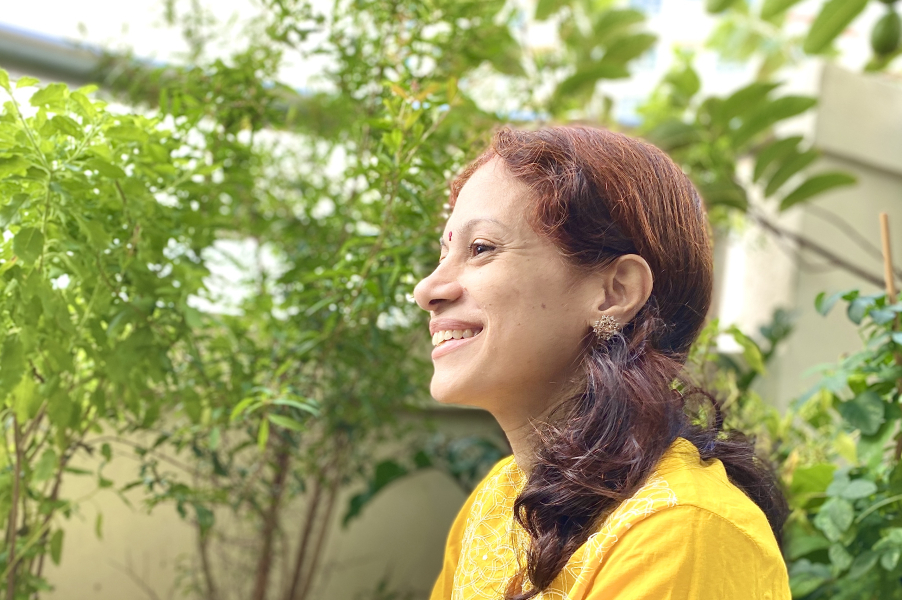
Nitya Mohan is the daughter of renowned yoga masters A.G. and Indra Mohan, who studied with Sri Krishnamacharya for nearly two decades. Trained in yoga, music and Sanskrit from childhood, Nitya holds a Graduate Degree in Classical Indian Music and is a master of Vedic chanting, Ancient musical texts and Sanskrit. She is the director of Svastha Yoga and Ayurveda training programs since 2001 and has trained hundreds of teachers. She is a skilled and compassionate teacher and an exceptional singer hailed for the purity of her voice.